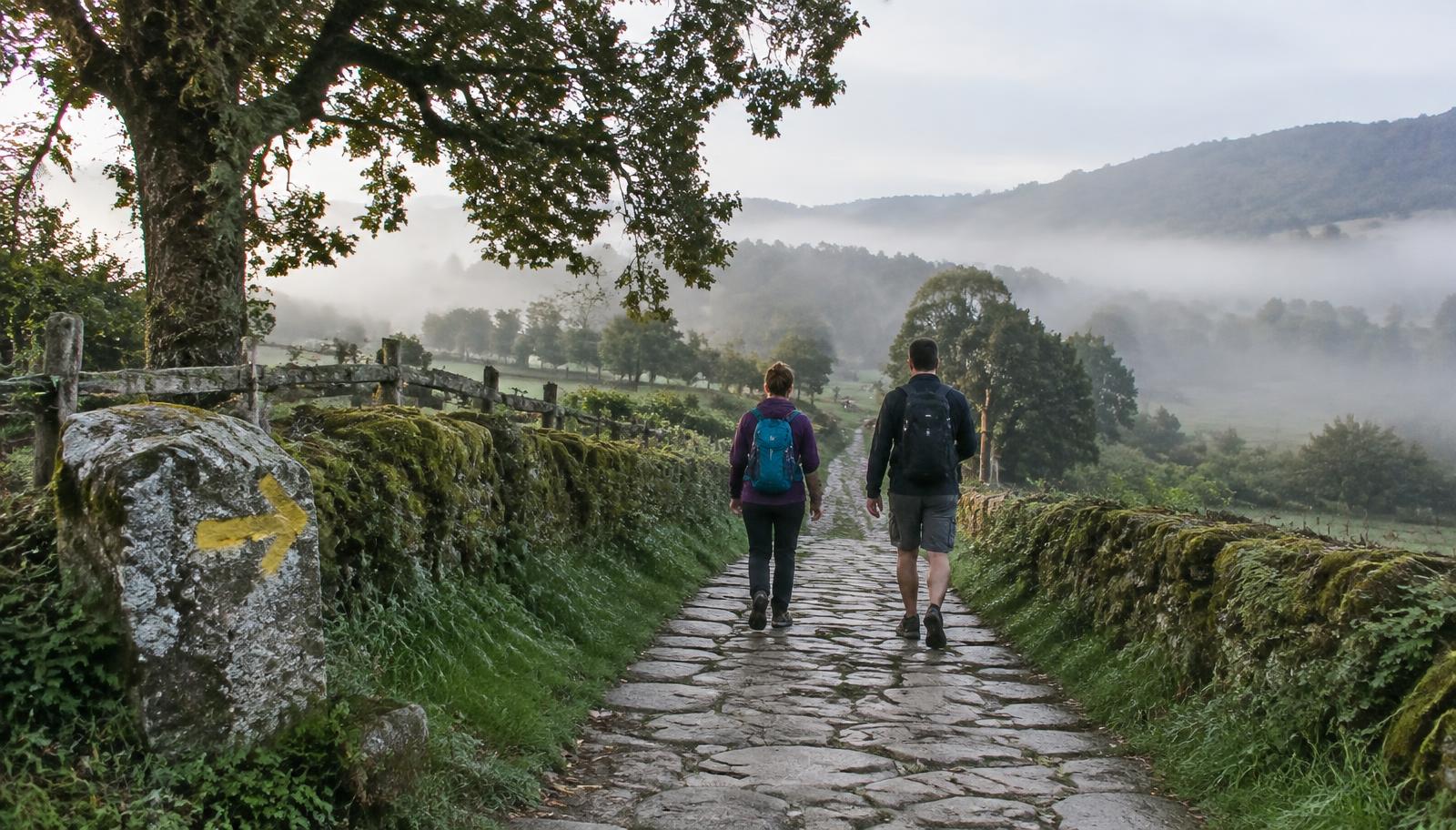
1. A Holy Year with room for your own rhythm
A Compostelan Holy Year, also called a Xacobeo, takes place when 25 July, the feast of St James, falls on a Sunday. That happens in 2027. For some visitors, the journey will be an expression of faith; for others, it will be a chance to walk, reflect and experience Santiago during a particularly meaningful year. There is room for both motivations.
Santiago Cathedral’s Holy Door opens at midday on 31 December 2026, earlier than the usual late-afternoon time, and remains open through 2027. The Archdiocese’s motto, “On seeing the star, they were overjoyed” from Matthew 2:10, offers a fitting thought to carry along the way. If religious observances are central to your plans, ask the Cathedral or Pilgrim’s Office about indulgence requirements.
The coastal approach does not remove the bustle of a Holy Year, especially as paths converge closer to Santiago. Its appeal is the atmosphere along the way: open horizons, seaside towns and opportunities to alternate walking with unhurried exploration. Think of it as a potentially calmer approach rather than a promise of solitude. Your dates, chosen sections and daily timing will all shape the experience.
2. From Porto to Viana do Castelo: beginning beside the Atlantic
Porto makes a memorable starting point, with its steep streets, tiled façades and riverfront beside the Douro. Before thinking about distances, give yourself time to settle into the journey. Watching the river move towards the ocean provides a natural introduction to a coastal Camino, where the landscape often becomes as important as the kilometres covered each day.
North of Porto, selected shoreline stretches bring beaches, promenades and boardwalks into the walking day. The attraction is straightforward: you can see where the land ends and the Atlantic begins. These settings can feel more open than enclosed urban approaches, although popular seaside areas also attract local walkers and visitors. Wind, rain and exposed sections remain part of the coastal experience.
Viana do Castelo adds a different texture, where the Lima River reaches the sea and the sanctuary of Santa Luzia stands above the town. A stay here allows the journey to include both maritime scenery and time among historic streets. With private transfers, there is no need to turn every connection into a walking stage; you can focus on a manageable coastal section and explore afterwards.
3. Baiona and Vigo: the Galician coast at walking pace
Across the border in Galicia, Baiona brings harbour views, old streets and the striking outline of the Monterreal fortress peninsula. It is a place where a short walk can feel satisfying without becoming a major undertaking. The pleasure lies in the changing perspective: boats in the water, stone walls above the shore and the broad sweep of the bay beyond.
Between Baiona and Vigo, selected coastal stretches offer views across the water and a sense of Galicia’s deeply maritime character. This is not one uninterrupted wilderness path. Settlements, roads and developed waterfronts are also part of the landscape. Choosing sections thoughtfully helps balance those realities with the sea views that make this part of the journey so appealing.
Vigo is a working city as well as a coastal stop, so expect urban energy rather than a secluded fishing village. Its setting on the ría gives the visit its character, with waterfront perspectives and opportunities to pause beside the water. The coast can still offer breathing space here, but the experience is richer when you welcome both the maritime scenery and everyday city life.
4. Understanding the route, from coastal walks to Santiago
It helps to distinguish a continuous, fully walked Camino from a private itinerary inspired by its most rewarding sections. Portugal Magik’s 10-day journey includes Porto, Viana do Castelo, Tui, O Porriño, Baiona, Vigo, Padrón and Santiago, using private transfers to connect visits and walks. These stops should not be read as a single, uninterrupted coastal walking line.
Tui and O Porriño are inland, associated with the Portuguese Central Way rather than the shoreline route. Their inclusion adds another perspective to the journey, particularly around Tui’s cathedral and its setting above the Minho River. Baiona and Vigo restore the coastal emphasis, while Padrón and Santiago carry the itinerary towards its destination. The car makes that combination practical without requiring every connecting kilometre on foot.
As coastal pilgrims join the shared approach towards Santiago, the sense of space can change. More walkers may be following the same waymarks, and Holy Year activity becomes more noticeable. Padrón offers a final change of scene before arrival in Santiago. Allow the journey to evolve rather than expecting sea views throughout: the coastal beginning and the inland conclusion have distinctly different characters.
5. Planning for a calmer Holy Year journey
Spring and autumn are generally calmer choices than July and August, although neither season guarantees quiet paths or settled weather. The days around 25 July are especially busy. Santiago also hosts the European Youth Pilgrimage from 15–18 July 2027, another date to keep in mind when deciding whether you want to join the Holy Year’s summer energy or travel outside it.
Book ahead, particularly if you have fixed dates or clear preferences for accommodation. Holy Year demand means hotels can fill early, and a coastal itinerary still needs careful planning for its Santiago stay. Leaving arrangements until late may limit your choices. A flexible departure date can help, but it should never be treated as a guarantee of availability.
Pack for a real Atlantic walk rather than a postcard version of one. A bright morning can turn breezy, and a level-looking stretch may still include uneven paving or slippery boards. The aim is not to carry everything imaginable, but to keep the walking day comfortable. These simple preparations are especially useful when combining coastal sections with sightseeing:
- Bring familiar walking shoes with dependable grip; avoid making the Camino their first outing.
- Carry a waterproof layer and a light extra layer for exposed coastal sections.
- Keep water, sun protection and personal essentials with you while your luggage travels separately.
- Discuss steps, uneven surfaces and mobility needs before selecting walks; short does not always mean accessible.
- Leave some flexibility in each day so walking choices can respond to conditions and how you feel.
6. How our private car-assisted Camino makes it easier
Portugal Magik’s private car support drops you off and picks you up so you can walk the best sections for your interests and abilities, then ride the rest. Luggage is taken care of every day. That changes the practical feel of the Camino: you can enjoy a coastal walk without carrying your main bag or needing to finish a long stage to reach your hotel.
Choose approximately 2–3 km daily at a Light pace, a gentle option suited to older travellers or people with walking limitations, with sightseeing by car and full assistance. Medium offers around 5–7 km for average walkers wanting nothing strenuous. Intense provides approximately 12–15 km for regular walkers and hikers, typically taking whole mornings or longer. Pace can change daily, and each person can walk a different distance.
Daily breakfast and hand-picked hotels are included, with 5-star boutique properties in the top tier. Comfort starts at €4,950, Premium at €5,650 and Private Deluxe at €7,250 per person, based on two guests; group discounts are available for three or more. Request a quote with your preferred dates, walking pace and priorities. Portugal Magik is a licensed Lisbon tour operator, RNAAT 228/13 and RNAVT 8506.
7. Arriving in Santiago: meaning before mileage
Before booking, decide whether receiving the Compostela is important to you. It requires completing the last 100 km on foot, or 200 km by bicycle, with two stamps a day on the final stretch. Walking selected sections and travelling the intervening distances by car does not satisfy that walking requirement. Do not assume that a car-assisted itinerary or an Intense pace automatically qualifies.
If the certificate is a priority, raise it at the planning stage and check the current requirements with the Pilgrim’s Office. If it is not, your journey can remain focused on the experiences that matter most to you: time beside the ocean, shared walks, historic towns or a personal moment in Santiago. A shorter daily distance need not make those experiences less meaningful.
The strongest reason to choose the coast in 2027 is not to escape the Holy Year entirely. It is to approach it with variety and a pace that suits you. Porto’s riverfront, Viana’s Atlantic setting and the waters around Baiona and Vigo give the journey its own character. By the time you reach Santiago, those coastal moments can feel just as important as the arrival.
Pick your walking pace
You don't need to be a hiker. Choose how much you'd like to walk each day.
Light
2–3 km a day
Short, gentle walks on the easiest stretches. The rest of the day is by private car, with sightseeing and full assistance.
Best for: Older travellers and anyone with walking limitations
Request this paceMedium
5–7 km a day
A relaxed walk of an hour or two on beautiful sections, then your driver takes you on. Nothing strenuous.
Best for: Average walkers with no walking issues
Request this paceIntense
12–15 km a day
Typically whole mornings or longer on the trail, with luggage handled and the car waiting at the end of the stage.
Best for: Regular walkers and hikers — advanced level
Request this paceDistances are approximate. Your car is private, so you can change pace day by day — and each person in your group can walk a different distance.
Walk the Camino with Portugal Magik
10 days on the Portuguese Coastal Route with private car assistance, luggage transfer and handpicked hotels.